Research Statement
Political borders – material, symbolic and theoretical – are perfect sites to explore my central research questions: what changes are occurring to political spaces today, on global and local scales, as a consequence of globalization (neoliberal trade agreements, new modes of communication, transnational corporate and other economic alliances)? How are these changes to political spaces affecting sovereignty, democracy, citizenship, war and other types of violence? What are their impacts on political and other forms of identifications (national, racial, ethnic, religious, worker, consumer, gender, sexual, posthuman)? Why is racism rising, especially in the form of attacks against migrants, and other minorities within nation-states, despite the gains of anti-colonial and Black Diasporic liberation movements? What are the prospects for equitable and just forms of living in the world today? Are alternative political spaces being produced for such equitable and just forms of life?
Since borders are used to establish the domain in which politics takes place and who the subjects are of that politics (who the politics is addressed to and who is excluded from it), if there are changes occurring to borders, there is likely a change occurring to the political and to the subjects of the political.[1] Scholars, artists, architects, politicians, laborers and migrants along with others have increasingly made borders the target of their analyses and politics in order to intervene in these issues, particularly since the fall of the Berlin Wall and the end of the Cold War camp configuration of world political relations.
The research that I conducted for my dissertation, titled Drawing the Lines of Conflict: Architecture, Borders, and a Critique of the Racial Violence of National Identities, addresses those central issues in two directions. First, it argues that as transnational economic factors are partially denationalizing states and challenging the sovereignty of nation-states, the lines that typically denote the peripheral edges of states (their limits) – the sovereign-national border – are becoming less clear, fixed, and certain symbolically.[2] As capital, labor and information move with increasing speed across state boundaries, it has become harder for individual states to manage the people (ethnos, Volk) as an imagined ethnic homogeneity. This has resulted not only in the increased walling between states, as Wendy Brown argues, but as I contend, it is also causing the sovereign-national border to move inside of states, as well as into non-state spaces. The kind of border that creates racial-ethnic absolutist territorial zones is proliferating everywhere inside, across, and in between political spaces. As this type of border moves and spreads inside the space of the political, authoritarian, anti-democratic, and racist, militant practices grow with them. In other words, authoritarian, anti-democratic, warlike relationships are expanding inside of democratic nation-states, especially in the global north.[3] I see this as a case of sovereign power – absolute power through institutions and technologies of the state which exercise the right to determine who gets to live and who gets to die – being decentralized and deterritorialized from the state and being applied more directly to individual bodies, particularly migrants and workers.[4] Evidence of this is seen in rising xenophobic and racist legislative policies and individual acts of violence against civilians within democratic pluralistic societies.[5] It is also being documented – and countered – by new curatorial, artistic, architectural and experimental research practices.[6]
Since the fall of the Berlin Wall, numerous architects in Europe, the Middle East, and North America have turned their attention to the political dimensions of borders, colonial occupation, state formation, and the increasing internationalization and militarization of city space. These architects not only document the impacts of globalization on the built environment, such as the proliferation of borders, but they too contribute to critical political theories of borders, states, nations and other forms of occupying space, as well as prospects for progressive political futures. Their research, architectural programs, exhibitions and installations, which intersect the politics of everyday life, borders, the ethics of aesthetics, and human rights discourses, contribute to a knowledge of how sovereign-national borders structure class, racial, ethnic, and religious amity and enmity within a world economy.
Works produced by Stefano Boeri and Multiplicity analyzing Europe and the West Bank show a pattern of proliferating border devices, a spreading authoritarianism divorced from any one state government, and a global north-south apartheid cartography emerging, whose origin, I contend, is the structural double bind of nation-states between the national community as an imagined racial homogeneity and the state as a collective of political agents, or citizens. The first chapter of my dissertation interpreted Boeri and Multiplicity’s “Border Syndrome: Notes for a Research Program,” “Border Matrix,” “Ghost Ship,” “Solid Sea,” “Road Map,” (2003) and “Trans-national Parasites” (2000) documentation of what they term the “polyarchic” spread of border devices (surveillance systems, security checkpoints, fences) as an effect of the confrontation between postcolonial and other migrants pluralizing presence with individual national imagined communities in Europe. Following the work of Hannah Arendt, Giorgio Agamben, and Etienne Balibar, I argue that globalization is enabling not a clash of civilizations, as Samuel Huntington famously argues, but rather a confrontation between the entwined histories between European colonialism, scientific racism, democratic revolutions, the rise of nation-states and world capitalist division of labor.[7]
That leads to the second way in which my dissertation research addresses my central research concerns. I argue that architectural analyses of political borders enable a rethinking of the relationships between sovereign-national borders, the structural violence of nation-states, and national identifications. Thus, it is here where my dissertation research contributes to a critical theory of sovereign-national borders.
Representations of the changing status of borders by architects reveal how sovereign-national borders produce militant, racist zones for the policing of national populations as fictive racial homogeneities.
Following Étienne Balibar’s work on borders, the nation form, and construction of national identifications, I argue that to identify with a nation-state requires that the individual be subject to a kind of forcing, or a “reduction of complexity” of one’s heterogeneous primary and secondary identifications.[8] This forcing occurs through a complex combination of civil and state apparatuses, such as military, police, governmental, educational, corporate, media, religious, and familial institutions. But nowhere is this force more obvious than at the entrance to the nation-state – the border checkpoint – in which individuals must provide documents in order to verify their status as a member of a nation and legitimate their identification with it. Because the entryway of the state is no longer solely located at the outer limit and can now be found inside cities within the state (e.g., international airport), but also symbolically through televisual and computer mediated forms of contact, border patrolling of populations is now more generalized throughout the political, especially in the global north where states are increasingly receiving nationalized others from the global south.[9] It is in this sense that every citizen within the polis is more and more a suspect, potentially a stranger, or an enemy of the state, hence, the draconian targeting of supposed undocumented persons, but it can also be seen in the increasing assault against civil liberties and civic activism in the public sphere, especially after the US declaration of a War on Terror.[10] The border is a kind of complexity-reducing machine, and states are increasingly unable to reduce the complexity of individuals within their populations. Migrants, members of African slave Diasporas and postcolonial Diasporas – individuals with allegiances to multiple nations – often resist identification with one national community. I call this process an “intensification of complexity” and I contend that documents by architects record both this trend and the notion of the border as a violent complexity-reducing machine. By presenting the heterogeneity that every border in fact produces, but that states want simplified and often violently purged from the body politic, the works of Teddy Cruz and Diller, Scofidio + Renfro contribute to radically democratizing the sovereign-national border.[11]
Borders are not inherently negative; nor do I think a borderless world polity possible. Some borders have more violent effects than others, for example the sovereign-national border produces more violence than a wall to a house, or a fence around a house.[12] Thus, the second and third chapters of my dissertation interprets the works of Teddy Cruz and Paul Virilio and Diller, Scofidio + Renfro in terms of how sovereign-national borders transform the space of the national into a battlefield through the construction of a way of looking at – or racially profiling – individual bodies within the boundaries of the state. Phenotypical, somatic features of individual bodies, but increasingly symbolic signifiers, such as language, religious paraphernalia, and clothing, are profiled in terms of whether or not an individual looks like they belong to the imagined national community. Looking like one belongs constitutes a friend or ally, whereas having the appearance of non-belonging hails individuals as enemies of the state, the latter who then are often targeted for punishment (detention), banishment (deportation), or extermination (destruction of immigrant camps). This mechanism aids the management and reproduction of precarious and ambiguous relations between classes, races and nations.
Teddy Cruz’s architectural analyses of the sixty-mile radius tangential to the US-Mexico border and encompassing the cities of Tijuana and San Diego documents the conflict and tensions between a zone of hybrid national cultures (an intensification of complexity) and the desire to cut off both physical and visual contact with that heterogeneity (reduction of complexity). The opaque fence that the United States uses to demarcate the beginning and ends of its nation-state is symbolic for the desire to contain American national identity around an imagined pure “white” European racial heritage.[13] Cruz’s work illustrates the ineffectiveness of the fence and the heavily militarized US border checkpoint to stop an informal transnational economy from flowing back and forth, tracking the fascinating importation and exportation of informal and formal infrastructural objects and practices between the San Diego and Tijuana. From the north, parts of San Diego’s aging post-war suburban development flows to south, such as garage doors, rubber tires, packing crates, and even entire bungalows, that are used to build emergency housing in Tijuana. From the south, migrant laborers from Latin America bring with them their self-organizing economies and practices, producing hybrid uses of space in San Diego and Los Angeles, filling in empty parking lots and abandoned buildings with informal marketplaces and community centers. The desire to extend an opaque wall along the United States border represents the attempt by the state to control and police ways of looking at individual bodies within the United States in terms of an imagined white racial being with European lineage – in this case, to rid the US national body politic of the heterogeneous self-organizing practices from Central and South America. The wall is also a way in which the US sovereign-national border both produces and manages the gross economic inequities that Cruz’s work also documents, being that the border is overdetermined by neoliberal trade agreement (NAFTA) and more recently Homeland Security initiatives, managing the competition between working class laborers in both countries and the uneven flow of capital, profit and products. Cruz intervenes in this condition through his architectural programs on both sides of the border. Working with local communities in both national contexts, the second chapter of my dissertation contends that Teddy Cruz’s practice not only “radicalizes the local” as he calls it, but so too does it radically democratize the sovereign-national border, using subaltern hybrid migrant practices to remake the border into a flexible adaptive line and space, instead of a rigid, militant battlefield.[14]
Diller + Scofidio’s analyses of the similarities between soldiers and tourists and the commemoration of wars and battlefields by museums for tourist consumption in Back to the Front: Tourisms of War, Hostility into Hospitality (1994), and suitCase Studies: the Production of a National Past (1991) offer insights into the ways in which sovereign-national borders operate like defensive frontlines on a battlefield. In addition, I argue that these documents reveal how militant and national forms of occupation use defensive borders in order to construct a field of vision for the policing of individual bodies within the state of occupation using class, racial and ethnic markers as a way to manage the divisions and competitions between them. Those divisions, however, are crucial for reproducing national identity or the ethnos as an imagined racial purity, so are never fully embraced as a part of the nation. Brown and black bodies from the African Diaspora or global south are thus policed (racially profiled) constantly in terms of not quite fitting the implied fictive ethnic order in western democracies in the global north. The presence of their phenotypical differences mark them as potential intruders or enemies whose visual and physical presence marks the pollution of the interior of an imagined pure state of whiteness that must be either killed, captured, or contained in order to preserve that invented racial purity. Reflecting on Paul Virilio’s seminal inquiry into the phenomenological and topological aspects of the concrete bunkers that the Nazi’s built along the Atlantic coast of northern France, Diller + Scofidio return to the space of the D-day landing to analyze its transformation into a tourist site for the consumption of war and national history.[15] Together with Virilio’s Bunker Archaelogy, my third chapter argues that Diller + Scofidio’s semiotic analyses of relations between tourist sites, battlefields, and the construction of national history, reveal the importance of visual surveillance and sightlines in managing the space of the nation as a battlefield. Thinking through the shifts to consumer societies within democracies in the global north and their transformations to what I term “states of souvenir-ity,” the connections between the reception of soldiers, tourists, and migrants is considered in terms of how national identities are produced and maintained as racial homogeneities.
The chapter also analyzes Diller, Scofidio + Renfro’s more recent collaboration with Virilio for the exhibition Native Land, Stop/Eject in which the issues of globalization, migration, environmental degradation, media relations and their effects on state territories, geography, democracy and human rights were explored.[16] Together with Laura Kurgan, Ben Rubin and Mark Hansen, Diller, Scofidio + Renfro produced a multimedia installation Video Control Room and Dynamic Maps as a visual companion piece to Virilio’s essay titled “Stop Eject” for the exhibition.[17] Their installations – a “living archive” and “dynamic maps” – represent the notion that movements across sovereign-national borders bind human relationships together more than attachments to territories. Documenting the reasons why humans are compelled to move across borders – economic, political and environmental – Video Control Room and Dynamic Maps represents what I call the “intensification of complexity” making fictive ethnic attachments to land increasingly difficult. As humans are compelled to move for to cities for work, to evade civil, ethnic and other forms of political strife, or for environmental reasons (floods, rising seas, droughts), sovereign-national borders become more difficult to defend. However, crossing borders into other nations, refugees and migrants are often stopped and ejected, as Virilio calls it, using a metaphor for the VCR and videocassette, from the host state. If island nations are drowning into the sea and off the map, because of rising sea levels caused by human made global warming, what use will the sovereign-national border have anymore?[18] Since environmental degradation threatens the coastal edges of states, also threatening state’s sovereignty, landed occupation will decrease and as Virilio suggests, the entire human population will be ejected from the planet. Diller, Scofidio + Renfro, et al.’s Dynamic Maps shift the representation of world political space from fictive ethnically bounded territories to migration itself. Can dynamic, constantly changing representations of data sets of movements of humans be used as the basis to conceive new forms of political relations from the fixed states of national sovereignty? My chapter concludes by exploring the possibilities for using movement itself as a concept for radically democratizing political borders and the creation of imagined mobile interconnected heterogeneous polities, instead of using national homogeneous identifications as the basis for bordering political communities.
Future Research
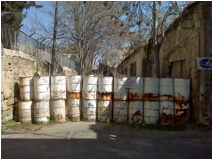
Building off of my dissertation research and my experience as a Visiting Lecturer for the University of Cyprus in Nicosia, I am now turning my attention to partitioned cities and “Green Lines” in Europe and the Mediterranean. In terms of the latter, some of the questions that drive my analysis of primary and secondary sources are: What are the origins, meanings, and effects of ceasefire lines, or “Green Lines” in Cyprus, Lebanon, and Palestine-Israel? What are the relationships between the construction of “Green Lines” and the workings and dissolution of Ottoman, British and French Empires? What does the political history of “Green Lines” contribute to understanding sovereign-national borders and national identifications? What do contemporary artists and architects representations of “Green Lines” and divided cities contribute to debates on ethnic, national and racial identifications? What can the architecture and spatial politics of “Green Lines” contribute to critical political theories of sovereignty, political identities, and territoriality? How do the architecture and spatial politics of “Green Lines” differ between each other and how do they compare to the architecture of sovereign-national borders? How are innovative architectural practices in the West Bank contributing to alternative equitable political futures?
In terms of my interest in partitioned cities, some questions my research will seek to answer are: what can a comparative analysis of two divided cities lying at the external borders of Europe – Belfast, Ireland and Nicosia, Cyprus – contribute to understanding normative assumptions about what constitutes “Europe”? What are the relationships between religious inclusion and exclusion and the production and maintenance of the external and internal borders of Europe and Europeanness? What do the particular historical circumstances of British colonization within Europe add to knowledge of the relationships between imperialism, nationalism, and religious differences? What do architectural analyses of partitioned cities within Europe contribute to the debates on the production of racial, religious, and national belonging and exclusion?